 Portrait Union
AI Watercolor Portrait From a Photo
Transparent washes on cotton paper, with the paper left to do the lighting
Updated 18 September 2026
Free preview — your photo in washes on cotton paper
The Watercolor style repaints a photo of a person or a pet in transparent washes on cold-pressed cotton paper: edges that dissolve into the background, blooms of soft colour behind the subject, and bare paper as the only highlight, because transparent watercolor has no white to add back.
Portrait Union's Watercolor style paints a photo of a person, a couple or a pet as a loose watercolor on cold-pressed cotton paper. The face, the markings and the expression are kept, and a person stays in their own clothes; what changes is how all of it is described. Skin and fur are built from thin transparent washes with the paper glowing through them. The shoulders and the outer edges bleed into a background wash of two or three soft colours instead of ending at a border. The lightest value in the picture is paper that was never painted at all, because transparent watercolor has no opaque white to add back once a wash has gone down. Two watermarked previews come back free, and the style's softness is the reason the memorial copy recommends it.
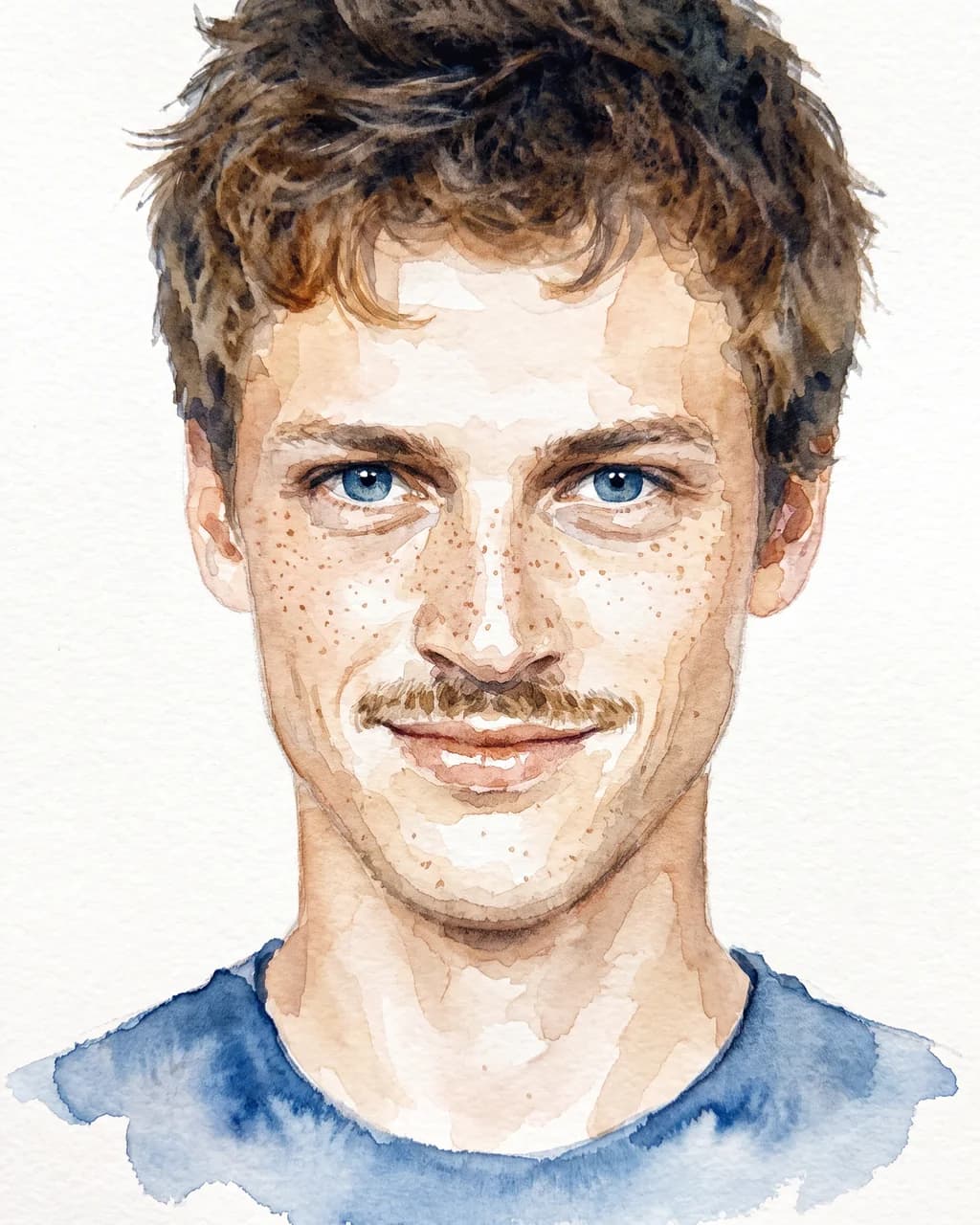
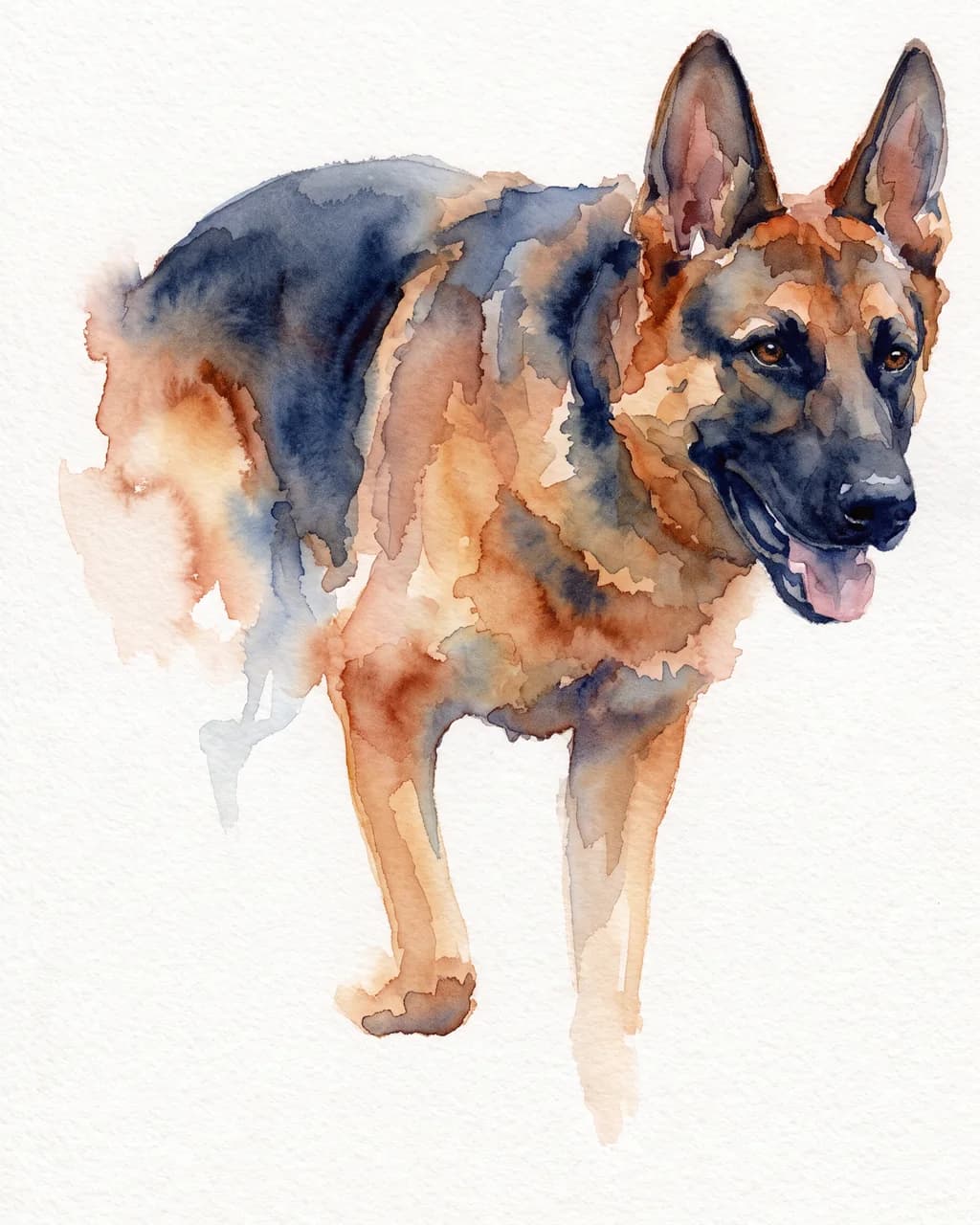
What a wash does to a photograph
The Watercolor style paints your photo as a loose watercolor on cold-pressed cotton paper. Everything is made of transparent washes: pigment settles into the tooth of the paper and granulates there, wet colour runs into wet colour so one shape bleeds into the next, and a crisp edge appears only where a wash was left to dry against itself. Behind the subject, two or three soft colours — a dusty blue-green, a muted rose, a warm ochre — go down while the paper is still wet, so the background blooms and runs rather than filling evenly, and a little bare paper is left breathing at the corners.
It is the quietest of the twelve styles and the one that behaves least like the others, which it can be because each style is a separately written prompt rather than one filter wearing twelve names. There is no crown, no armour and no invented setting: a person keeps the clothes they were photographed in, and a pet keeps its own body and its own pose. The handling of the paint is the whole of the decoration, which is why it is the style suggested for a memorial portrait and the one people choose when they want something that can hang in a hallway without announcing itself.
What is kept and what changes. Kept: the exact face — eyes, nose, mouth, proportions, skin tone, hair colour and hair length — a pet's species, breed and markings, the expression, and the person's own contemporary clothes. Reinterpreted: the edges, which dissolve into the background wash instead of stopping at a border; the modelling of skin and fur, rebuilt out of thin overlapping washes with the paper showing through rather than out of opaque paint; and the background, which becomes a bloom of colour rather than a place you could name.
Coats and fabrics take a wash differently, and it is worth knowing which way round before you upload. Long, soft or double coats — a retriever's feathering, a Persian cat's ruff, a spaniel's ears — are what the medium is best at, because a wet-in-wet bleed is already the shape of soft fur. A knitted jumper, a linen shirt or loose hair behave the same way. Fine hard-edged detail is the thing to watch: washes describe it with a few confident dry-brush marks rather than drawing it line by line, so a thin chain, wire-framed glasses, a printed logo or a tightly patterned fabric come back suggested rather than reproduced. Freckles, a white chest patch and a folded ear survive perfectly well, because those are shapes rather than lines.
Best photographs for a Watercolor portrait: evenly lit, head-and-shoulders or head-to-chest, with the subject clearly separated from whatever is behind it. A slightly soft or slightly low-contrast photo is no obstacle here, which is why this is the style we suggest for an old phone picture of a pet who has died. What fights the style is a dark, heavily backlit photo, or a busy background pressed right up against the subject: transparent washes have nothing opaque to cut a shape back out with, so the two tend to run together. The photo is centre-cropped to 4:5 before anything is painted, so keep the subject near the middle of an upright frame.
On canvas the medium travels better than it sounds as though it should. A gallery canvas is stretched over a wooden frame, so 49 mm of picture on each edge folds around the sides; rather than printing a white border, the print file mirrors the outer band of the painting around every edge, and on this style that band is mostly open wash and bare paper, so the sides continue as colour instead of cutting through the subject. At 20×25 cm the blooms read as one soft field of colour. At 40×50 cm the separate washes start to come apart. At 60×75 cm the granulation and the dry-brush marks are individually visible, and the weave of the canvas stands in for the tooth of the paper.
What this page covers
The paper is the highlight — It is the only style page whose lightest value is not paint at all: transparent watercolor reserves the white of the cotton paper instead of adding an opaque white over the top, so every highlight here is a piece of paper that was left alone rather than a mark that was made.
Where the edges go — It explains the one thing this medium does that no other style on the site does, which is to let the shoulders and the outer contour bleed into the background wash rather than end at a border, with a crisp edge appearing only where one wash was left to dry against another.
Which coats and fabrics suit a wash — It says which textures the washes flatter and which they only suggest: long and double coats, loose hair, knitted wool and linen are what wet-in-wet bleeding is best at, while a thin chain, wire-framed glasses, a printed logo or a tightly patterned fabric come back as a few dry-brush marks rather than as drawn detail.
What the canvas wrap takes on a wash — It is the page that works out what the 49 mm mirrored wrap means for a style whose corners are bare paper: the band folded around the sides is open wash rather than subject, so the sides of the canvas continue as colour, and it says what the blooms, the granulation and the dry-brush marks look like at 20×25, 40×50 and 60×75 cm.
Five centuries of the same medium — Its history section is about watercolor itself rather than about one painter: Dürer's studies in the Albertina, the English landscape school and Turner's bequest to the nation, and the American watercolors of Homer and Sargent that made the medium a serious way to paint a person.
What you get
Transparent washes
Pigment settling into cold-pressed paper, wet-in-wet blooms, and a crisp edge only where a wash dried against itself
The paper does the lighting
No opaque white anywhere: the highlights are bare paper, the way transparent watercolor has always worked
Face and clothes kept
Exact features, skin tone, hair colour and length, a pet's breed and markings, and the clothes you were photographed in
Edges that dissolve
Shoulders and outer contours bleed into the background wash instead of ending at a border
The quiet style
No crown, no armour, no invented setting — for a portrait meant to hang without announcing itself
The preview is free. Upload one photo, choose a style, and look at two watermarked paintings before you decide whether to keep anything.
What makes a painting a watercolor?
Watercolor is pigment ground into gum arabic and thinned with water, laid on paper in layers thin enough to see through. That transparency decides everything else about the medium. Colour is built by letting one wash dry and floating another over it, so the picture gets darker but never lighter, and the only white available is paper that was never painted. Albrecht Dürer's studies of about 1502 to 1503 in the Albertina in Vienna — the hare, the piece of turf — are the early demonstration that this could be a finished work rather than a note made on the way to an oil painting.
The medium became a school of its own in eighteenth- and nineteenth-century Britain, where Paul Sandby, Thomas Girtin and above all J. M. W. Turner used washes on paper to paint weather and light directly. Turner left the contents of his studio to the nation, and the Turner Bequest at Tate runs to some thirty thousand works on paper: an argument, item by item, that a wash could carry a whole picture. Later in the nineteenth century Winslow Homer and John Singer Sargent took the same transparency to people and animals, Sargent working so quickly that the reserved paper whites are the drawing; the Brooklyn Museum bought a group of his watercolors in 1909 and the Museum of Fine Arts in Boston another in 1912.
Portrait Union's Watercolor style is written against that tradition rather than against a photographic effect. The painting is asked for on cold-pressed cotton paper, in transparent washes that pool and granulate, with wet-in-wet blooms behind the subject, hard edges only where a wash has dried against itself, and the paper's own white kept as the lightest value. What it does not do is the part that matters: no opaque body colour over the top, no airbrushed gradient, no photographic finish underneath. The face and the markings come from your photograph; everything around them is handled the way the medium has been handled since Dürer.
Sources: Watercolor painting (Wikipedia) · Dürer's watercolours at the Albertina, Vienna · J. M. W. Turner and the Turner Bequest — Tate · John Singer Sargent (Wikipedia)
What does a Watercolor portrait cost?
No packs, no credits, no subscription. You see a free watermarked preview first and pay only if you want to keep it.
| Product | What is included | Price |
|---|---|---|
| Gallery canvas | Portraits print at 20×25, 40×50 or 60×75 cm; restorations add the 2:3, 3:4, landscape and square sizes. Shipping and digital files included. | from €69.99 |
| Framed canvas | Portraits print at 20×25 or 40×50 cm; restorations add the 2:3, 3:4, landscape and square sizes. Black, Dark brown, Natural wood frame, ready to hang, shipping and digital files included. | from €129.99 |
| Digital portrait | One file, 2048 × 2560 px, without watermark | €4.99 |
| Both variants | Two files, portraits only, save €1.99 | €7.99 |
Prices shown in EUR. In the UK a digital portrait is £3.99 and a canvas starts at £59.99; in the US, Canada, Australia, New Zealand, Japan, Singapore and Korea they are $4.99 and $79.99. The preview page charges in your own currency automatically.
Frequently asked questions
Will it look like a real watercolor or like a filter?
It is generated as a painting rather than applied as a filter: the washes pool and granulate in the paper's tooth, the background blooms unevenly, and the paper grain runs through the whole image including the white of the highlights. A filter leaves the photograph's own edges and shadows underneath, which is exactly what this style does not do.
Does the face stay recognisable under all that wash?
Yes. Eyes, nose, mouth, proportions, skin tone, hair colour and hair length are kept from your photo, and the darkest accents — the eyes, the brows, the lips — are painted in last so the face still reads. Two free previews let you check before you pay anything.
Can I have my pet painted in Watercolor?
Yes, and it is one of the better matches. Fur is exactly what a wet-in-wet wash describes well, and the breed, the markings and the eye colour come from your photo. The animal keeps its natural anatomy and wears no costume in this style, at most its own collar.
My photo is a bit soft. Is that a problem?
Less of a problem here than in any other style. A watercolor is made of soft transitions, so a slightly soft or slightly flat photo has somewhere to go. What does fight it is a very dark or heavily backlit photo, or a busy background right up against the subject, because transparent washes cannot cut a shape back out of what is behind it.
Does a watercolor print well on canvas?
It does, and the canvas weave stands in for the tooth of the paper. The 49 mm that folds around the sides of a gallery canvas is mirrored from the outer band of the painting, which on this style is mostly open wash, so nothing of the subject is lost around the edge. Gallery canvas starts at €69.99 and framed canvas at €129.99, shipping included.
How is this different from the Van Gogh style?
They are opposite ends of the same argument about paint. Van Gogh Style is opaque and thick — impasto, swirling directional strokes, saturated complementary colour — and it repaints the background as a landscape. Watercolor is transparent and thin, the paper shows through everywhere, the edges dissolve instead of building up, and the background stays an abstract bloom of colour.