 Portrait Union
AI Van Gogh Style Portrait
Yourself painted in swirling post-impressionist brushwork
Updated 2 October 2026 · First published 3 September 2026
Free preview — see yourself in swirling brushwork
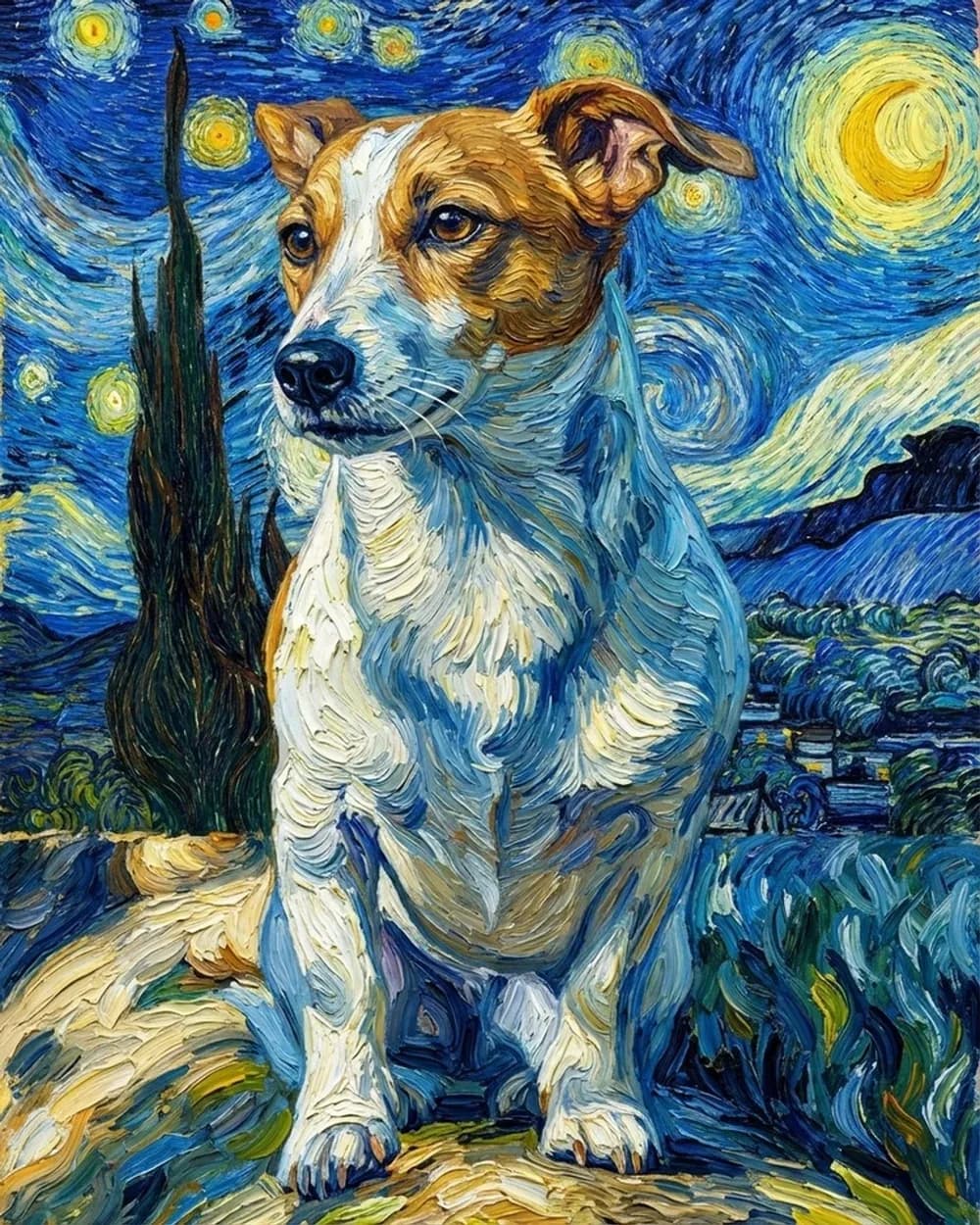
The Van Gogh style repaints a photo of a person or a pet in swirling impasto brushwork and a post-impressionist palette of cobalt, chrome yellow, ochre and Prussian green. The face, the hair and your own clothing stay recognisable, which makes it the one style here that does not dress you as something else.
The Van Gogh style repaints a photograph of a person or a pet in the manner of Vincent van Gogh's late period. The face, the hair and the expression are kept, and so is your own clothing, which makes this the one style on the site that does not change what you were wearing. Everything else is painted in thick directional impasto, in a palette of cobalt blue, chrome yellow, ochre and Prussian green, and the background dissolves into wheat fields, a starry sky, sunflowers or cypress trees. Pet fur becomes a study in brushwork, so long-haired breeds and strongly marked cats suit it particularly well. A watermarked preview comes back free before anything is bought, and that impasto texture is the reason this style is worth seeing on canvas rather than only on a screen.
The model is instructed to keep the face, the markings and the expression from your photograph. The free watermarked preview is where you decide whether it did, before anything is paid for.
What the Van Gogh style does to a photo
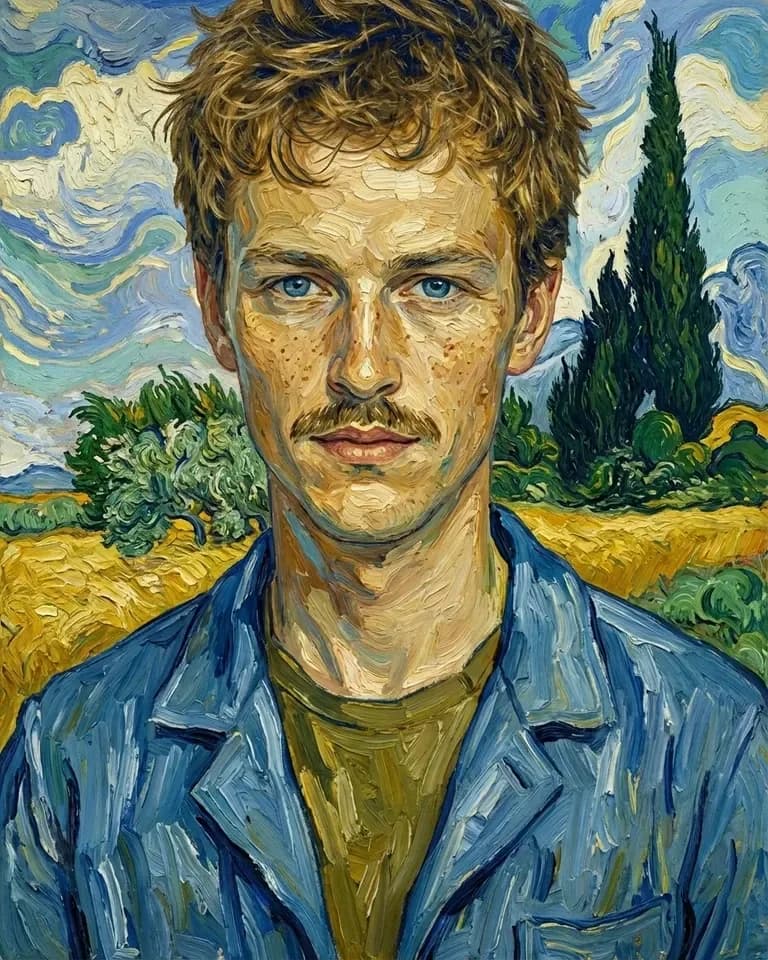
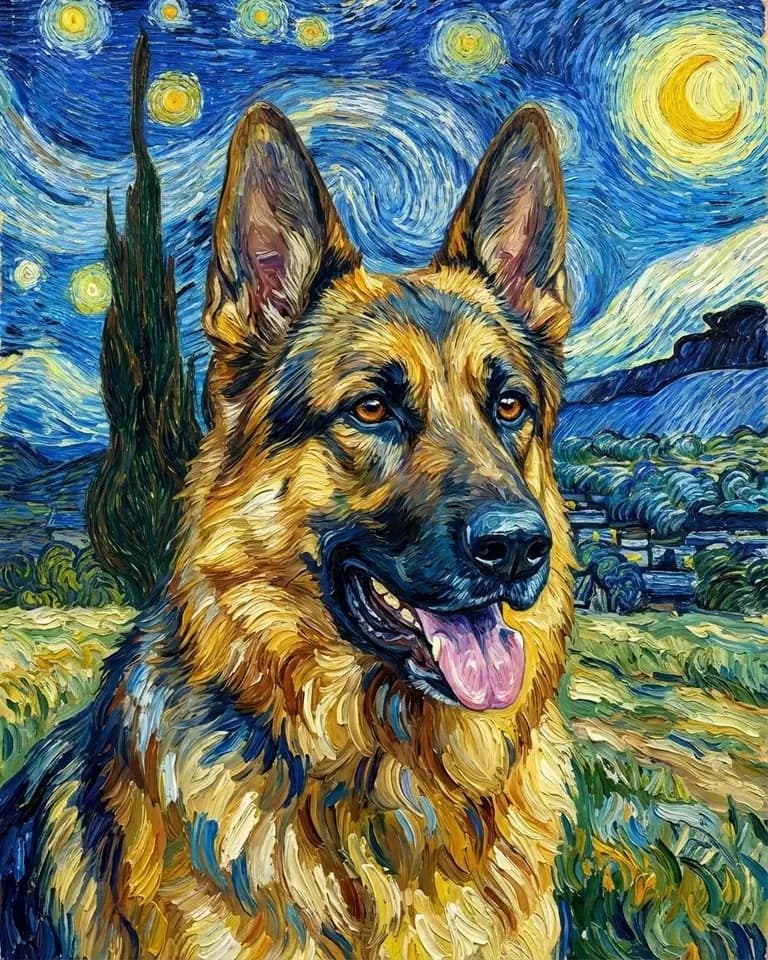
The Van Gogh style paints any photo as a post-impressionist oil painting in the visual language of Vincent van Gogh's late period. That means swirling directional brushwork, thick impasto laid on with palette knife and round brush, and a saturated palette of cobalt blue, chrome yellow, ochre and Prussian green. The face keeps its own features while the fabric, hair and background dissolve into the painterly turbulence Van Gogh used to convey energy.
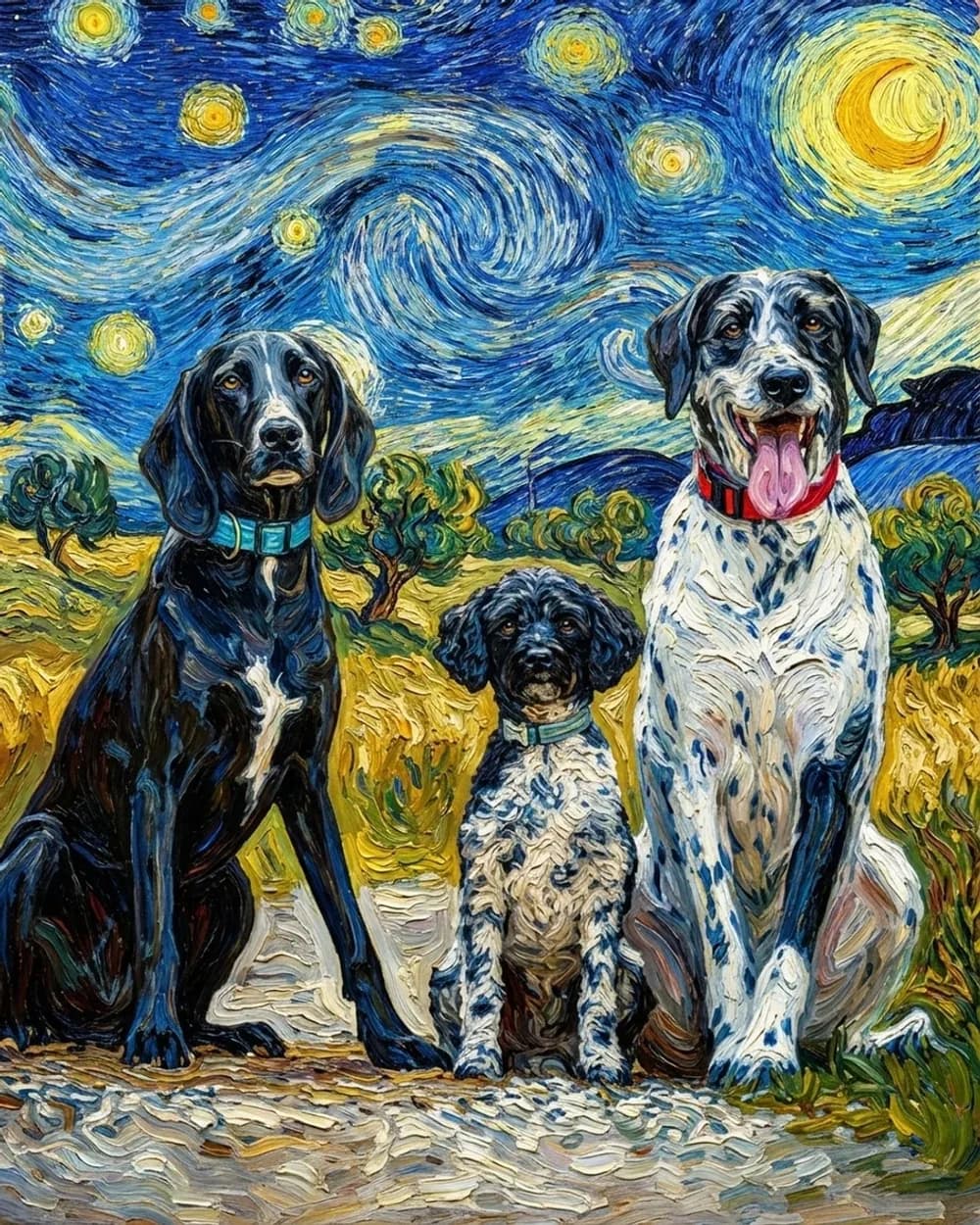
It works for individuals, couples, families and pets. Self-portraits in this style echo Van Gogh's own, with the three-quarter angle, the intense gaze and the swirling palette behind. Pet portraits are unexpectedly good: dog fur and cat fur become a study in directional brushwork, and the coloured backgrounds, a chrome-yellow Provençal sun or a deep cobalt starry sky, set them off.
What is kept and what changes. Kept: facial features, eyes, expression, hair colour, hair style, skin tone, pet breed and markings, and your own clothing. Reinterpreted: clothing texture, which becomes brushy painted fabric; hair, which becomes swirling painted strands; and the background, which dissolves into Van Gogh's landscapes of wheat fields, starry skies, sunflowers, cypress trees and the Provence countryside.
Best photos for Van Gogh portraits, over and above what the photo guide asks of any upload: head-and-shoulders or head-to-chest framing, a three-quarter angle, eye contact with the camera. The style works on tightly cropped headshots and on wider compositions. Heavily filtered photos work less well because they fight the painterly interpretation. Any skin tone, age, hair texture or hairstyle works. Van Gogh painted everyone he knew, postal workers, doctors, his brother, himself, and the style accommodates the same range today.
What this page covers
Kept against reinterpreted — It lists both sides of the line explicitly: facial features, eyes, expression, hair colour and style, skin tone, pet breed and markings and your own clothing are kept, while clothing texture, hair and background dissolve into painted turbulence.
The palette named — It names the late-period colours the style works in, cobalt blue, chrome yellow, ochre and Prussian green, and the thick impasto laid on with palette knife and round brush that produces the texture.
The Arles portraits, cited — Its history section places the mature style in Arles and Saint-Rémy, names the Roulin, Gachet and Ginoux portraits and the landscapes the backgrounds are drawn from, and links the Van Gogh Museum in Amsterdam and MoMA.
What you get
Swirling brushwork
Directional impasto strokes, palette-knife texture and a painted oil finish throughout
Post-impressionist palette
Cobalt blue, chrome yellow, ochre, Prussian green: Van Gogh's late-period colour vocabulary
Face and clothes kept
Facial features, hair colour, hair style, expression and your own clothing are painted from the source photo
Painterly backgrounds
Wheat fields, starry skies, sunflowers, cypress trees, Provençal countryside
Works for pets too
Dog fur and cat fur become a study in directional brushwork, especially on long-haired breeds
The preview is free. Upload one photo, choose a style, and look at the watermarked painting before you decide whether to keep it.
Painted from photographs like yours
Every portrait and every restoration here is made by an image model working from the photograph it is given, not painted by a person at an easel. These are samples, not customer work.
What defines Van Gogh's post-impressionist style?
Vincent van Gogh (1853–1890) produced over 2,100 artworks across a ten-year painting career, most of them in his final two years in Arles and Saint-Rémy. His mature style, the one Portrait Union's Van Gogh portraits reference, emerged in the late 1880s. It is characterised by thick impasto applied with palette knife and round brush, and by swirling directional brushwork that conveys movement and emotion. The palette is saturated and complementary: cobalt blue against chrome yellow, Prussian green against ochre.
His best-known portraits — the self-portraits, Portrait of Joseph Roulin (the postman), Portrait of Dr. Gachet, and the Madame Ginoux series — establish the visual language: three-quarter framing, intense direct gaze, vibrantly painted background that dissolves into mood rather than realistic setting. His landscapes — The Starry Night, Wheatfield with Crows, Café Terrace at Night, Sunflowers — provide the iconic backgrounds the AI draws from when generating Van Gogh-style portraits today.
Portrait Union's Van Gogh style generates portraits with thick, directional brushwork (rendered as visible impasto in the digital image and preserved in canvas print), Van Gogh's signature palette, and emotional rather than literal backgrounds. Faces are kept faithful to the source photo. Van Gogh himself painted real people, and the modern portrait keeps that grounding in likeness while applying the painterly interpretation to everything around the face.
Sources: Vincent van Gogh (Wikipedia) · Van Gogh Museum, Amsterdam · Post-Impressionism (Wikipedia) · The Starry Night — MoMA
What does a Van Gogh style portrait cost?
No packs, no credits, no subscription. You see a free watermarked preview first and pay only if you want to keep it.
| Product | What is included | Price |
|---|---|---|
| Gallery canvas | Portraits print at 20×25, 40×50 or 60×75 cm; restorations add the 2:3, 3:4, landscape and square sizes. Shipping and the digital file included. | from €69.99 |
| Framed canvas | Portraits print at 20×25 or 40×50 cm; restorations add the 2:3, 3:4, landscape and square sizes. Black, Dark brown, Natural wood frame, ready to hang, shipping and the digital file included. | from €129.99 |
| Digital portrait | One file, 2048 × 2560 px, without watermark | €4.99 |
Prices shown in EUR. In the UK a digital portrait is £3.99 and a canvas starts at £59.99; in the US, Canada, Australia, New Zealand, Japan, Singapore and Korea they are $4.99 and $79.99. The preview page charges in your own currency automatically.
Frequently asked questions
Will it look like a real Van Gogh painting or a digital filter?
A painting, not a filter: it is generated as an oil painting with thick directional impasto, visible brush marks and canvas texture. The prompt asks for heavy paint texture across face, fabric and background, so the image reads as a painting at any distance, including on canvas at 60×75 cm.
Does the face stay recognisable?
Yes. The model is instructed to keep eyes, nose, mouth, ears, proportions, skin tone and hair details. Only the surrounding fabric, hair texture and background are reinterpreted, and your own clothing is kept.
Can I do a pet Van Gogh portrait?
It works well. Pet fur becomes directional brushwork; backgrounds bring in wheat fields, sunflowers or cobalt skies. Cats with strong markings and long-haired dogs such as retrievers, collies and samoyeds suit it.
Is this good for printing on canvas?
Excellent for canvas: the impasto texture in the digital file carries onto the print, so the canvas reads as a painted piece rather than a photographic print.
Can I do a couple or family in Van Gogh style?
The style takes several subjects: each face stays faithful while the surroundings swirl into one composition. It suits couples, one on each side with the painted background between them, and families of three to five.
How does this differ from Renaissance Royal?
Renaissance Royal is courtly, formal, baroque: royal attire, golden glazes, dignified. Van Gogh Style is intimate, emotional, post-impressionist: swirling brushwork, vibrant colour, painterly turbulence. Renaissance Royal flatters formal occasions; Van Gogh flatters personality and inner life.