 Portrait Union
AI Greek God Portrait Generator
Become a deity of Olympus in classical art
Updated 9 October 2026 · First published 3 September 2026
Free preview — see yourself on Mount Olympus
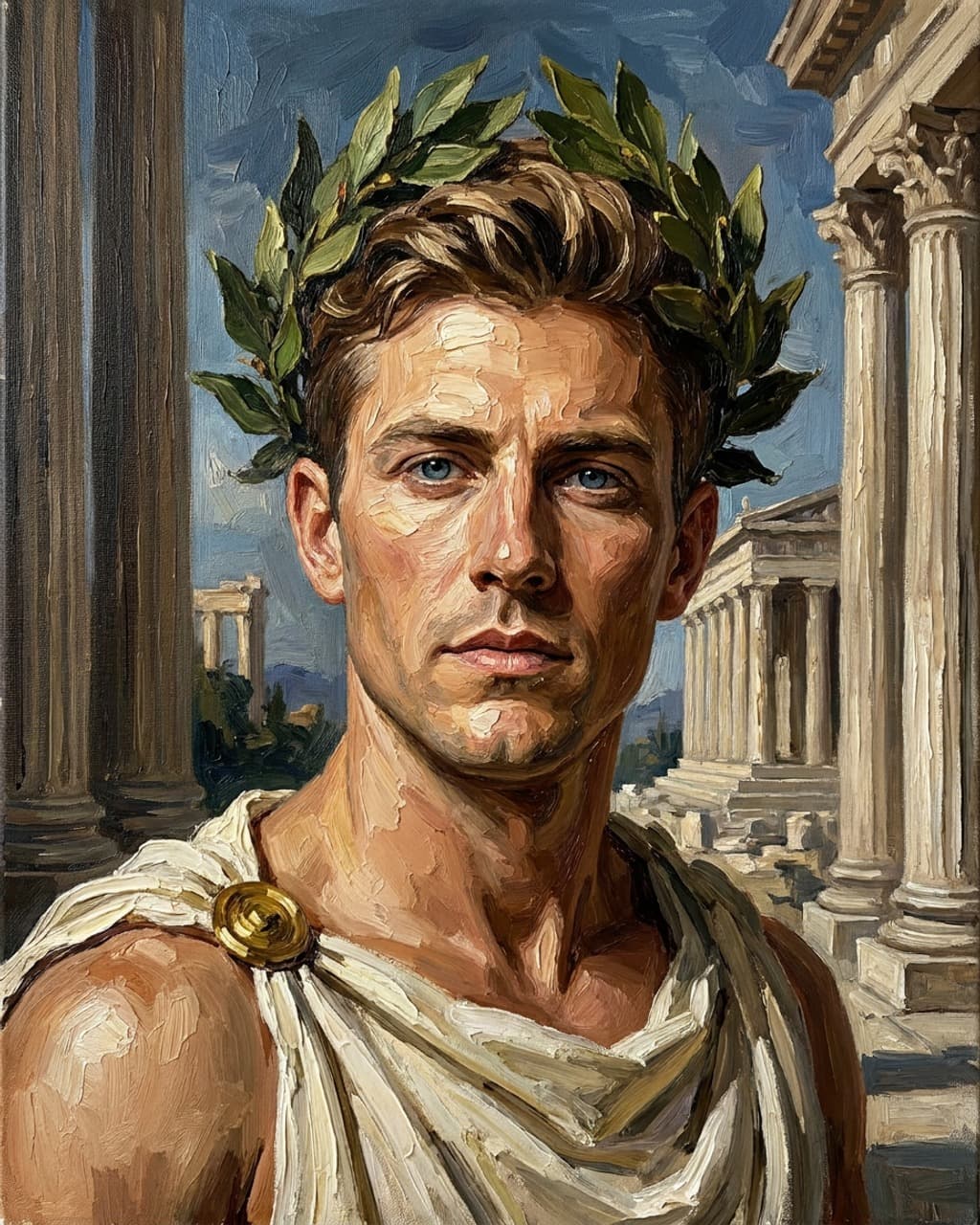
The Greek God style builds a classical figure around a face: a chiton or himation in ivory and stone tones, a laurel crown over the hair, gold clasps at the shoulder and a contrapposto stance, against Doric or Ionic columns. The finish is an oil painting with warm glazes, never a photograph.
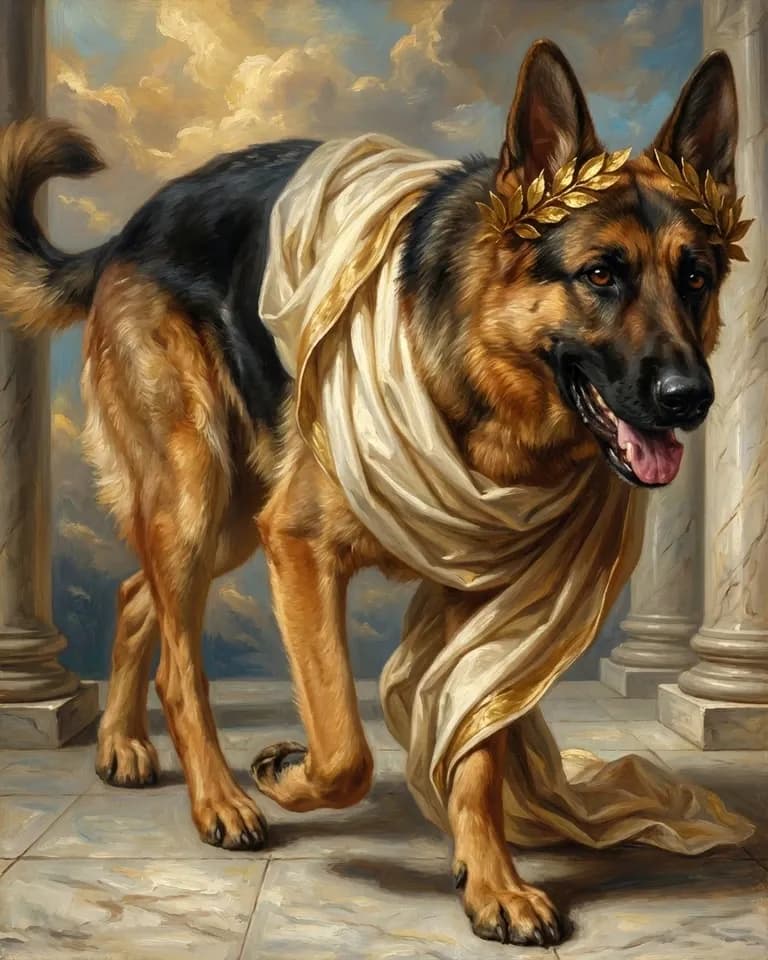
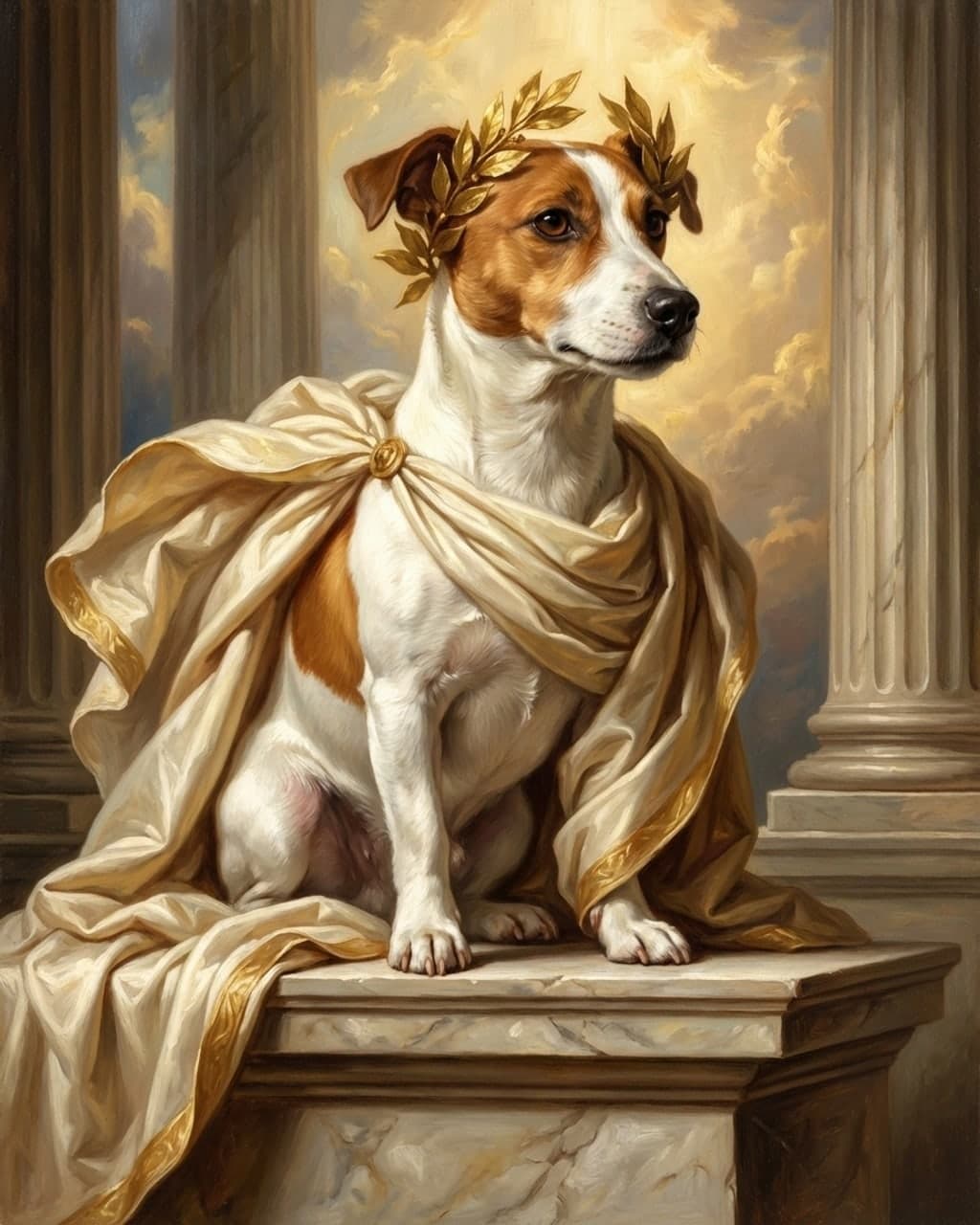
What the Greek God style paints is classical dress and classical architecture arranged around the face in your photograph, which is left alone. The garment is a chiton or himation in ivory and stone tones with gold clasps at the shoulder, the stance is contrapposto, and the laurel crown rests on the hair. The setting is the part that varies most: the Parthenon, an unnamed Doric temple, the Aegean coast, mist over olive groves, or an interior with red-figure pottery and bronze tripods, so no two portraits come back with the same setting. Columns are Doric or Ionic rather than generic ruins. A pet in this style wears a small laurel wreath and perhaps a thin gold collar over its own animal body. Drapery and light shift with every generation, and the preview is free before any of it is bought.
The model is instructed to keep the face, the markings and the expression from your photograph. The free watermarked preview is where you decide whether it did, before anything is paid for.
What the Greek God style does to a photo
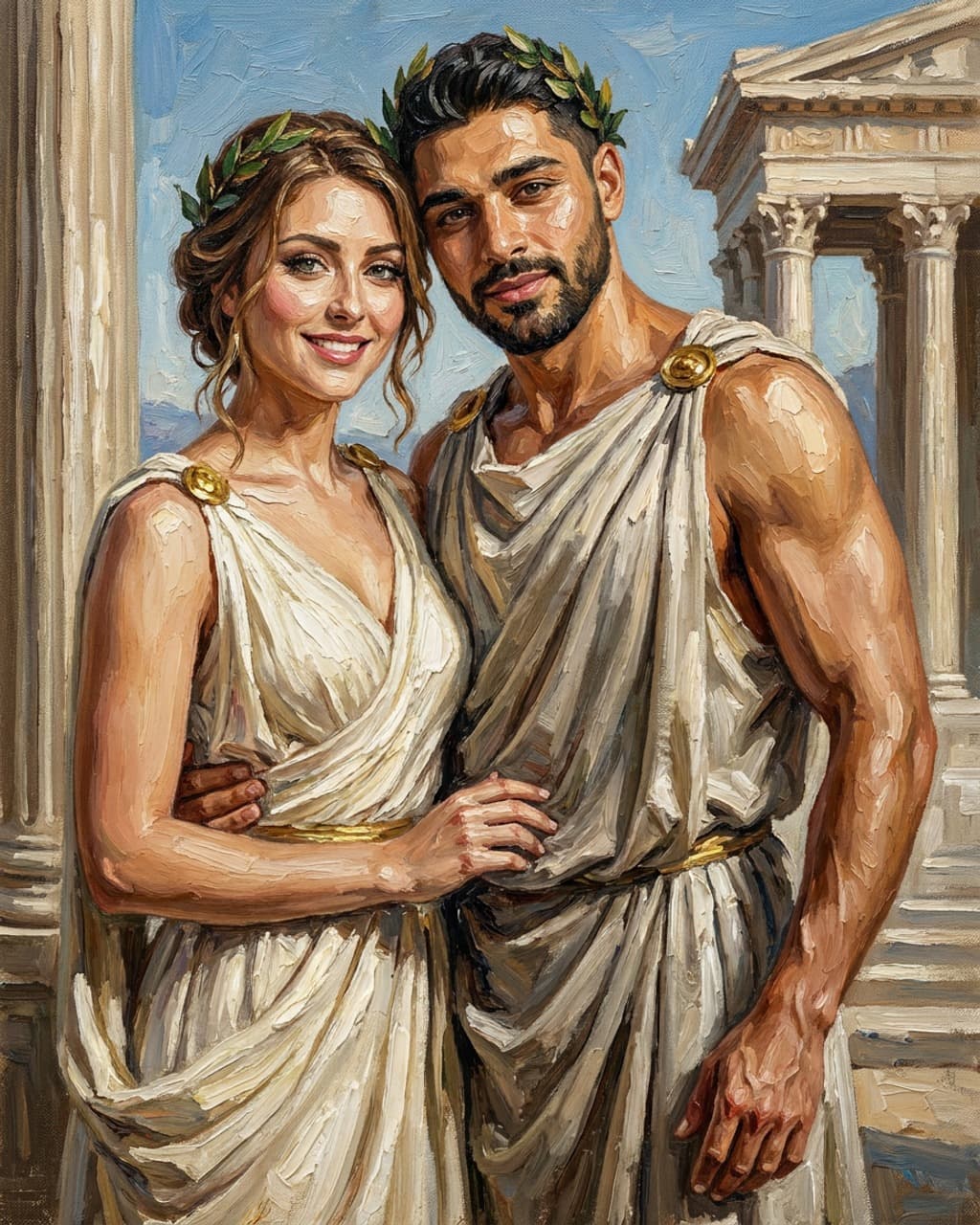
The Greek God style paints any subject as a figure from classical mythology. The costume is a flowing chiton or toga in ivory and stone tones, a laurel crown and gold clasps at the shoulder; the setting is marble columns, temple steps and Mediterranean sky. The finish is an oil painting with warm light and visible brushwork, never a photo.
It works for any subject. People get the full treatment: chiton or toga, a relaxed classical stance, marble and golden light. Pets wear a small laurel wreath and perhaps a thin gold collar, never human clothes, and keep their own four-legged body. Couples appear together in matching drapery, which reads as a divine pair without naming one.
Who it suits. Lifters and athletes, for the heroic posture and the drapery across the shoulders; it hangs well by a home gym. Readers of myth and ancient history, for the correct chiton draping, the jewellery forms and the real Greek architecture. Couples marking an anniversary, for the divine-pair reading.
Generation takes under a minute for your preview. Backgrounds vary between the Parthenon, an unnamed Doric temple, the Aegean coast, mist over olive groves, or an interior with red-figure pottery and bronze tripods. No two Greek God portraits are identical, even from the same source photo.
The style pairs with Renaissance Royal or Samurai Warrior on a multi-style gallery wall; dogs and cats in this style have their own royal pet portrait page. What a canvas costs, and what that price already includes, is on the pricing page.
What this page covers
Classical detail named — It specifies what the style actually puts in the picture: a chiton or himation in ivory and stone tones, a laurel crown, gold clasps at the shoulder, a contrapposto stance, and Doric and Ionic columns rather than generic ruins.
Hellenistic sculpture, cited — Its history section dates the move from idealised Archaic figures to individual likeness in the Hellenistic period, names Lysippos, the Laocoön Group, Raphael's School of Athens and Jacques-Louis David, and links the British Museum and Wikipedia.
Backgrounds that will differ — It lists what the setting can come back as — the Parthenon, an unnamed Doric temple, the Aegean coast, mist over olive groves, or an interior with red-figure pottery and bronze tripods — so a visitor knows before generating that the setting will vary.
What you get
Classical attire
Chiton, toga, ivory and stone tones, laurel crown, gold clasps
Classical setting
Marble columns, Mediterranean sky, temple architecture: real Greek visual vocabulary
Oil painting finish
Renaissance-classical glazes, dramatic chiaroscuro, sculptural modelling, never photorealistic
Any subject
Individuals, couples, families and pets; pets in laurel wreaths and gold collars
Unique each time
Background, drapery folds and lighting direction vary with every generation
The preview is free. Upload one photo, choose a style, and look at the watermarked painting before you decide whether to keep it.
Painted from photographs like yours
Every portrait and every restoration here is made by an image model working from the photograph it is given, not painted by a person at an easel. These are samples, not customer work.
What is classical Greek portraiture?
Classical Greek portraiture emerged during the Hellenistic period (323–31 BCE) as a fusion of earlier idealised sculpture and a new interest in individual likeness. Earlier Archaic and Classical Greek art (8th–4th centuries BCE) tended toward idealised, anonymous figures — gods, athletes, generic citizens. The Hellenistic shift brought naturalistic faces, individualised expressions, and dramatic emotional range, exemplified by works like the Laocoön Group and the busts of Alexander the Great by Lysippos.
The visual vocabulary that Portrait Union's Greek God style draws from is consistent across the surviving art. It includes the draped chiton and himation in soft folds, laurel wreaths for heroic figures, contrapposto (weight on one leg) for dynamic posture, marble settings, and an architectural language of Doric and Ionic columns. Later Roman and Renaissance painters, from Raphael's School of Athens to Jacques-Louis David's Neoclassical works, continued and codified this classical-mythological visual language.
Portrait Union's Greek God style is rendered as a Renaissance-classical oil painting, not a photo-realistic reconstruction. Warm glazes, chiaroscuro and oil-paint texture evoke the way Renaissance and Neoclassical painters depicted mythological subjects. The faithful elements, chiton draping, laurel form, column proportions, reference real ancient sources while the painted finish places the portrait in the European fine-art tradition of representing antiquity.
Sources: Hellenistic art (Wikipedia) · Greek art at the British Museum · Classical antiquity (Wikipedia) · Neoclassicism in painting (Wikipedia)
What does a Greek God portrait cost?
No packs, no credits, no subscription. You see a free watermarked preview first and pay only if you want to keep it.
| Product | What is included | Price |
|---|---|---|
| Gallery canvas | Portraits print at 20×25, 40×50 or 60×75 cm; restorations add the 2:3, 3:4, landscape and square sizes. Shipping and the digital file included. | from €69.99 |
| Framed canvas | Portraits print at 20×25 or 40×50 cm; restorations add the 2:3, 3:4, landscape and square sizes. Black, Dark brown, Natural wood frame, ready to hang, shipping and the digital file included. | from €129.99 |
| Digital portrait | One file, 2048 × 2560 px, without watermark | €4.99 |
Prices shown in EUR. In the UK a digital portrait is £3.99 and a canvas starts at £59.99; in the US, Canada, Australia, New Zealand, Japan, Singapore and Korea they are $4.99 and $79.99. The preview page charges in your own currency automatically.
Frequently asked questions
Does it work for pets?
Pets get a small laurel wreath and perhaps a thin gold collar, never human clothes, and keep their own body. It suits golden retrievers, ginger cats and any pet whose bearing reads as regal.
Will my face look the same?
Yes. The model is instructed to keep facial features, skin tone, hair colour, style and length; the laurel crown sits on top of the hair, never woven into it. Only the attire and the setting change.
What if I want a specific god or goddess?
Each portrait reads as broadly classical rather than tied to one deity, because the visual elements, chiton, laurel, marble, are shared across mythology. Couples often read as a divine pair, Zeus and Hera or Ares and Aphrodite, without being labelled.
Is this a good gift for someone into Greek mythology?
It suits someone into Greek mythology, especially paired with a copy of the Iliad or a modern retelling, and it suits classics students and gym-goers who like heroic-classical iconography.
How does it compare to Renaissance Royal?
Renaissance Royal is closer to court portraiture: crowns, velvet robes, ermine trim, baroque palaces. Greek God is closer to classical antiquity: draped fabric, laurel, marble, Mediterranean light. Both are oil-painted styles; pick regal-baroque or heroic-classical.
Does the drapery need more than a head-and-shoulders photo?
A little more helps. People are painted from the head down to about the waist, which is the room the chiton, the gold clasps and the laurel need in order to read as anything; a tight crop of a face leaves the style almost nowhere to drape. Look for an upright photo with the subject near the middle and even light on the face.